Pablo Picasso
Musical Instruments on a Table
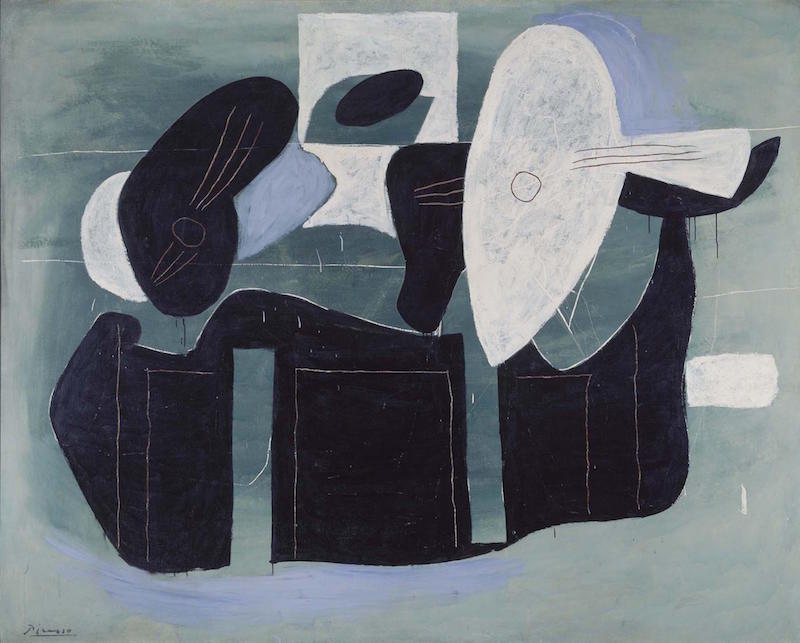
From the end of the First World War, Pablo Picasso worked on different styles and expressive forms by turns in his work, becoming one of the first artists to embark upon the so-called “return to order”, the avant-garde’s return to realism, characteristic of the interwar period. Although he would not relinquish Cubism altogether, Picasso did progressively simplify and schematise, arriving at the essential. During the summers in the period stretching from 1919 to 1925, Picasso approached the still-life theme by virtue of a series of elements arranged on a table in front of an open window. Across this time span he would replace the angled outlines of Cubism with curvilinear contours and organic forms, drawing inspiration from the contemporary painting of Surrealist painters such as Joan Miró and André Masson.
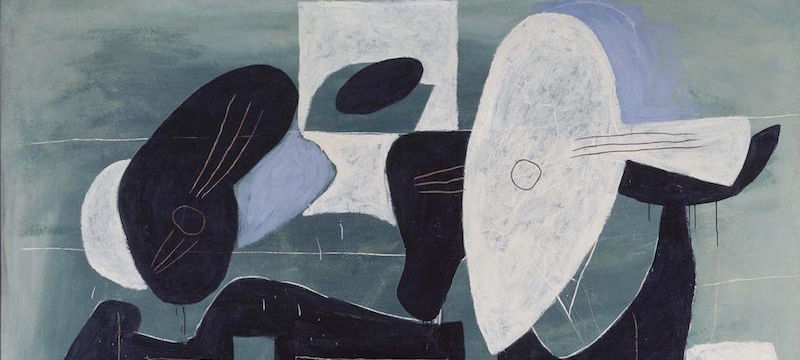
In Instruments de musique sur une table (Musical Instruments on a Table), Picasso reaches an extreme synthesis — the room space is confused with the table surface, of which there is only mention via the black shadow that is cast and the contours of the table legs. In the background a white rectangle simulates a window, and on the right, another seems to indicate a door. The three elements on the table — guitar, mandolin, fruit — appear to be floating on its surface, while the sole trace of suggested reality is the profile of a woman, almost imperceptibly painted in white on the mandolin, as if she were playing it.
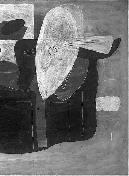
With Instruments de musique sur une table, macro-photography contributes valuable details on Pablo Picasso’s creative process. Firstly, the artist applied a diluted layer of sap green on the already primed canvas. This process meant the grounding was barely covered by colour, leaving the weft of the canvas exposed. We can also note micro fissures which affect the layers of colour.
Picasso later darkened the central area with a richer green, forming a base for the different elements that form the still-life. The play with the intensification of other colours means we can still make out the green in the small spaces which have not been covered with brushstrokes.
The artist would subsequently use incision drawing, tracing grooves and applying pressure on the painting’s surface with the end of a brush or another solid instrument. Some of the most protruding lines have been painted on these previous grooves, for instance those representing the strings of the instruments, under which we can perceive the green corresponding to the base. Nevertheless, other lines in the composition, such as those used to draw the human figure, have been applied directly on the base.
Furthermore, the presence of blue, white and black paint drips and splashing point to the colours being applied with a brush thick with paint, with the artist maintaining fast, assured strokes. These details, along with the incisions, suggest nimble workmanship with a rapid execution.
Interestingly, we can see how the long bristles of a brush caught in the layers of colour are still conserved, for instance in the green form that appears to represent the shadow of the instrument on the right.
Of note is also the bordering brown tape, or gummed tape, which was commonly used on old restorations to protect the sides of the canvas.
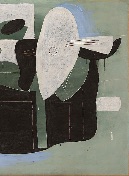
The different responses of materials to ultraviolet light help to distinguish with greater clarity the many instances of colour retouching made on the sides of the work. The chromatic retouching, covering abrasions and scratches on the pictorial layer, become visible as much darker strokes and are profuse on the upper right and in the four corners of the canvas.
Also visible is the precise, and smaller in scale, retouching work carried out in black that appears under ultraviolet light as dark dots which are deeper than the original background. This highlights an abrasion at the top of the instrument on the left.
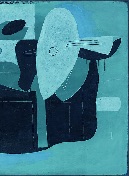
Of further interest in Instruments de musique sur une table is the diluted application of the green paint in the background. Via infrared digital photography, we can see how light layers run as they are applied, akin to gouache.
The contrast between the execution of white and black areas also catches the eye. The images show how the whites contain more pictorial matter, as well as indicating a rapid movement of the paintbrush, while in the black areas the strokes are barely visible and have a lighter paint density.
Although the lines of the drawing have definition, as with the figure on the right, we cannot see any lines from an underlying drawing or corrections made to the composition.