Salvador Dalí
Cubist Self-Portrait
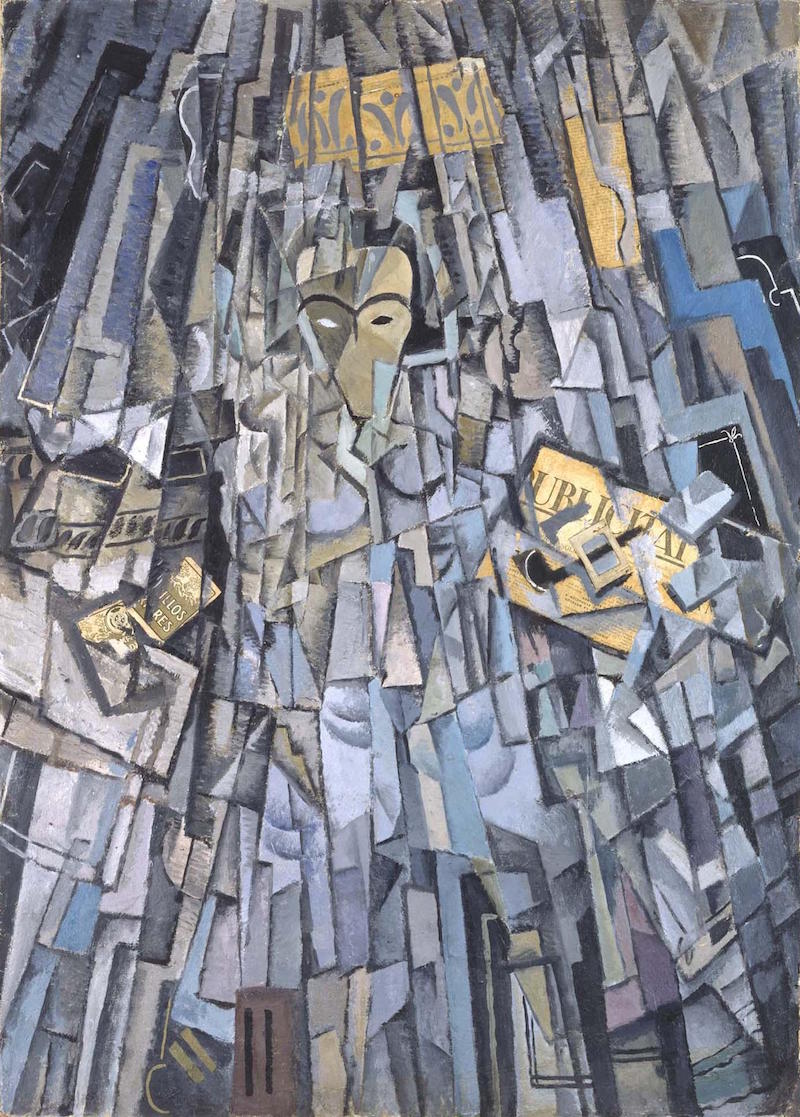
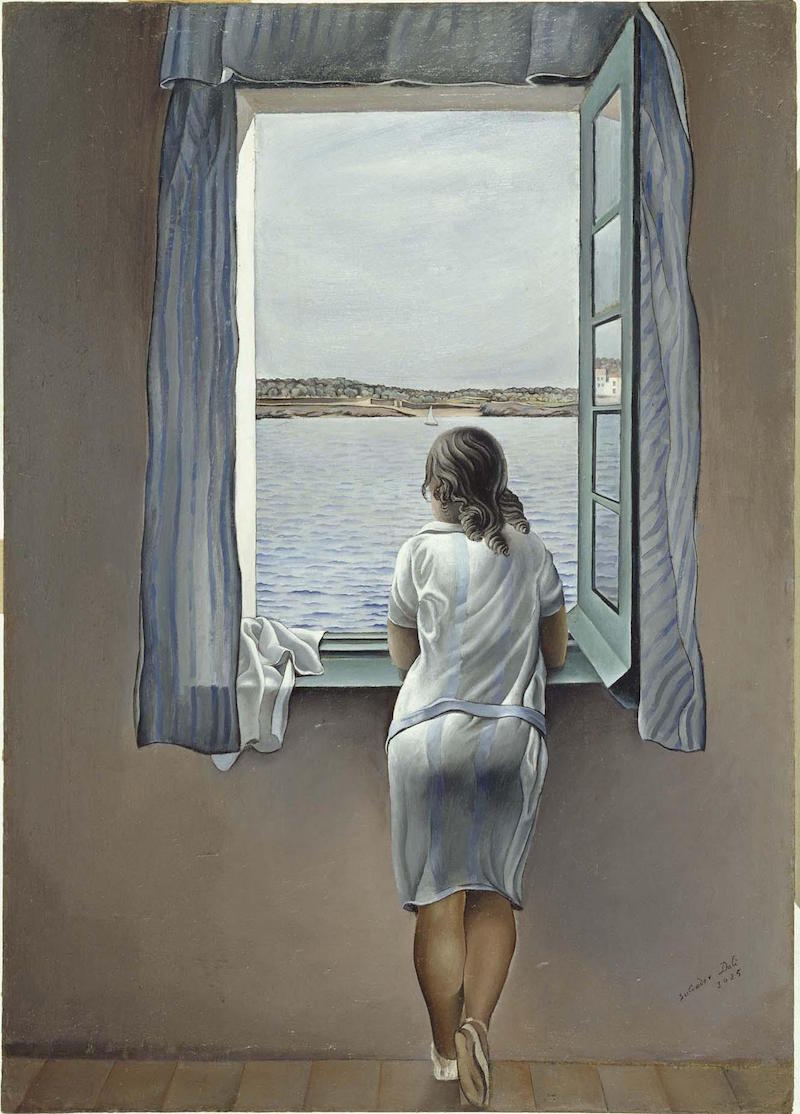
For a young Salvador Dalí, the early 1920s were a time of investigation. Before embarking on his Surrealist period in 1927, the artist experimented simultaneously with two of the predominant styles of the time, Cubism and Realism, taking references from magazines such as Valori Plastici, from Italy, and the French publication L’Esprit Nouveau. Notable among his realist works is the series of portraits of his family that he produced between Figueras and Cadaqués, particularly of his sister Anna Maria, the focal point of six of the seventeen paintings Dalí displayed at his first solo show at Galeries Dalmau (Barcelona) in 1925.
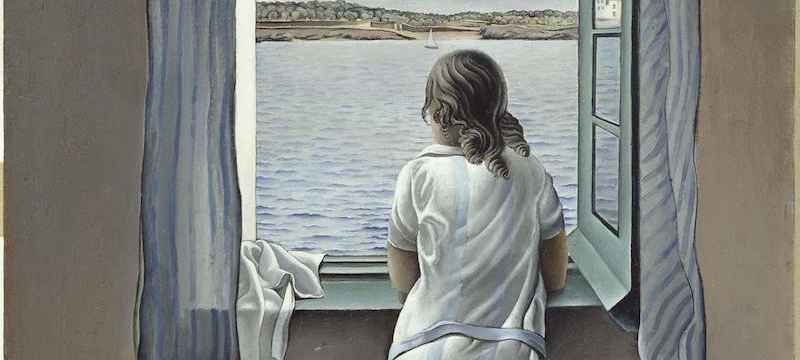
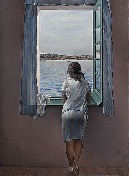
Figura en una finestra (Figure at the Window) is a balanced, classicist and Mediterranean composition indebted to Ingres and Picasso, whereby Dalí depicts his sister with her back turned as she looks out of a window and contemplates the landscape of the bay of Cadaqués. A landscape that recalls, in its stillness and horizontality, and even in its positioning, that which is represented in Andrea Mantegna’s Death of the Virgin, a work which Dalí had observed at the Museo del Prado and which he would also use — albeit only in the reference to the clouds — in his portrait of Luis Buñuel.
Dalí painted this paradigmatic work using solid paperboard as a support, which lends the work a smooth and gentle appearance.
The enlarged detail on the corners shows the ease with which the fibres of the paperboard have flaked, a common deterioration in supports of this kind, and are hidden under the frame.
The enlarged detail on the corners shows the ease with which the fibres of the paperboard have flaked, a common deterioration in supports of this kind, and are hidden under the frame.
The enlarged detail on the corners shows the ease with which the fibres of the paperboard have flaked, a common deterioration in supports of this kind, and are hidden under the frame.
The enlarged detail on the corners shows the ease with which the fibres of the paperboard have flaked, a common deterioration in supports of this kind, and are hidden under the frame.
This light also reveals surface irregularities and damages to the work. We can note craquelure in the pictorial layer located on the back of Anna Maria, the artist’s model and sister, while there are small losses of colour between cracks as we zoom in.
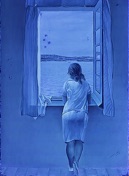
The visual study under ultraviolet light enables small areas which have undergone restoration interventions in the past to be discerned. The dark purple dots relate to former retouching processes, concealing damages or losses to the original paint. It also highlights retouching work carried out on the sky we see through the window, on the wall, and around the edge of the work. On enlarging the image to obtain greater detail, we can perfectly differentiate the added colour of the original paint.
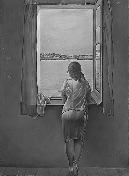
This tool is key to discovering the preparatory drawings which are not detectable to the naked eye.
In this case, if we enlarge the image on the floor tiles on the bottom right corner of the picture, the infrared reveals what could be a grid to realign the composition. These charcoal gridlines which segment the background are a customary system of prior compositional outlining often found in the works of Salvador Dalí.